
Choice of wavelength and eye safety
For lidars, two choices of wavelength are popular:
- near infrared, e.g. 850 nm, 865 nm, 905 nm, 940 nm
- 1550 nm
The main advantage of near IR is that silicon is sensitive in that region, allowing much cheaper, more sensitive silicon detectors, as well as cheap laser sources. In contrast, with 1550 nm, you would need InGaAs semiconductors for your detectors, which are less sensitive and very expensive.
Meanwhile, the main advantage of 1550 nm is that eye safety regulations allow devices to output vastly more power at 1550 nm than in the near IR regime. As a result, 1550 nm lidars tend to have longer range in general.
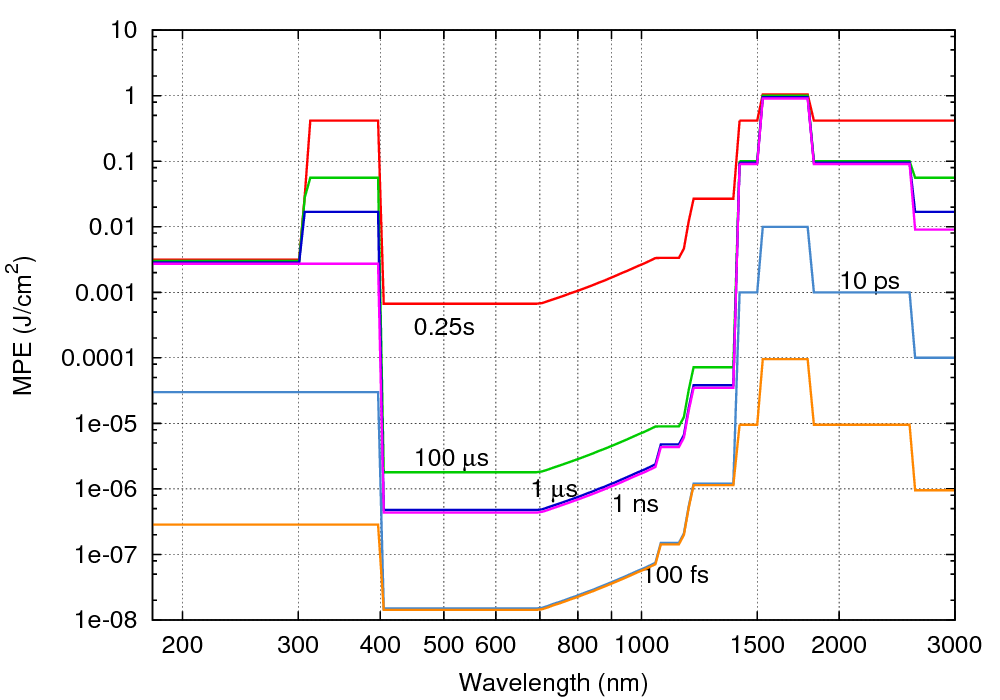

You can see in the above chart that you are allowed to output hundreds of times more power in the steady state scenario (red curve) at 1550 nm compared to, say, 905 nm. The reason is that the human eyeball focuses near IR light to small spots on the retina, so intense light may damage the retina. On the other hand, 1550 nm light is not focused and is attenuated by water, but at high enough intensities, it will damage the cornea instead.
In practice, manufacturers carefully tune the power of the lasers to be just below the eye safety threshold for both 1550 nm lidars and near IR lidars. That is to say, 1550 nm lidars do in fact output up to 1,000,000 times more pulse energy than 905 nm ones.
Paradoxically, 1550 nm lidars may be more dangerous overall, because of the following reasons:
- If you have many lidars around, the beams from each 905 nm lidar will be focused to a different spot on your retina, and you are no worse off than if there was a single lidar. But if there are many 1550 nm lidars around, their beams will have a cumulative effect at heating up your cornea, potentially exceeding the safety threshold.
- 1550 nm lidars more often rely on beam steering since it is impractical to have an array of expensive fiber lasers. However, if the beam steering were to fail, the laser beam may be fixed in one direction. This can cause laser energy levels thousands of times stronger than the safety threshold in a particular direction, even when the lidar would be under the threshold when it’s scanning properly.
- 1550 nm lidars are known to damage cameras. For example, both AEye lidars and Luminar lidars on the Volvo EX90 are known to destroy cameras. This is an especially worrisome problem with pulsed 1550 nm lidar, but FMCW lidars have a continuous wave with lower peak power and may be slightly safer.
Eye safety aside, 1550 nm is also somewhat more attenuated by both water and water vapor, so they are likely to perform worse in poor weather. In fog, Mie scattering of the water droplets may also impact 1550 nm lidar more, as fog droplets are about 1.5 microns, and the scattering is more as the size of the sphere approaches the wavelength. That said, 1550 nm lidars do have better range to begin with, thanks to outputting a lot more power, so even with attenuation, they are still competitive in rainy situations.